
Question 1
Microbiology Final Exam. Select all 5 correct statements:
- Gram-positive bacteria appear blue/violet after the Gram stain procedure, whereas Gram-negative bacteria appear red/pink.
- Bacteria’s shape can be Bacillus (rod-shaped), Coccus (spherical-shaped), Spiral, Star-shaped or Rectangular.
- Understanding how microbes spread helps nurses prevent healthcare-associated infections.
- In nomenclature the genus is capitalized and the species is lowercase.
- The human body contains more bacterial cells than human cells.
- Plasmids are small extrachromosomal circles of RNA
- The bacteria’s flagella is composed of two parts: Filament and Hook
- Staphylococcus aureus on skin is always beneficial
- Microbiology focuses mainly on bacteria found in laboratory settings
- Siderophores are pigment-containing cells or organelles that allow organisms to change color
Question 2
Select all 5 correct statements:
- Pseudomonadales includes Pseudomonas species that cause infections in immunocompromised patients.
- Salmonella Typhi causes typhoid fever.
- Chlamydia trachomatis causes trachoma and urethritis.
- Virulence describes the degree of pathogenicity.
- A lower ID-50 value generally means higher virulence.
- Psychrophiles microorganisms grow in hot environments.
- Growth media cannot have selective and differential characteristics at the same time.
- Virulence is the ability of a microorganism to cause disease.
- Streptococcus mutans uses a glycocalyx (dextran) to stick to tooth enamel.
Question 3
Select all 5 correct statements:
- Complement activation can be initiated by three pathways: Classical, Alternative, and Lectin.
- Granulocytes are polymorphonuclear leukocytes (PMNs) that are typically associated with innate immunity.
- Interferons (IFNs) are small proteins produced by virally infected cells that act as chemical signals to protect neighboring cells.
- Cytopathic effects (CPEs) are visible changes in a host cell caused by a viral infection.
- The complement system is part of the humoral, innate immune system and enhances the ability of antibodies and phagocytic cells to clear microbes.
- Biofilms are structures that are easily removed by chemical disinfectants.
- Adaptive immunity is the first line of defense against pathogens.
- The adaptive immune system does not interact with the innate immune system.
Question 4
Identify the following infection: Viral infection caused by the reactivation of the chickenpox virus, leading to a painful, blistering rash that typically appears on one side of the body or face.
- Acanthamoeba keratitis
- Candida infection
- Shingles
- Warts
Question 5
Identify the following infection: Viral infection that can appear on various parts of the body, most commonly on the hands, feet, or genital area.
- Acanthamoeba keratitis
- Candida infection
- Shingles
- Warts
Question 3
Select all 5 statements that are correct. Microbiology Final Exam
- Cytopathic effects are the structural changes in host cells caused by viral invasion.
- Complement activation always requires antibodies and cannot occur without them.
- Adaptive immunity is acquired after exposure and has memory.
- Acute inflammation develops slowly over months or years and often leads to tissue damage.
- Granulocytes include neutrophils, basophils, and eosinophils.
- Interferons are antibodies that directly lyse bacteria in the bloodstream.
- The three main activation pathways of complement system are classical, alternative, and lectin.
- Innate immunity is present at birth and provides a rapid, nonspecific response.
- Innate immunity relies mainly on T and B lymphocytes that recognize specific antigens.
- Biofilms do not contribute to bacterial resistance against antibiotics and disinfectants.
Question 4
Select all 5 statements that are correct.
- Both bubonic and pneumonic plague have very low mortality rates and usually resolve without treatment.
- Chikungunya is caused by the Chikungunya virus and is transmitted to humans by $\textit{Aedes}$ mosquitoes.
- Rh incompatibility affects the first pregnancy.
- Blood type AB has both anti-A and anti-B antibodies.
- Septic shock is a severe, life-threatening stage of sepsis characterized by dangerously low blood pressure.
- Endocarditis is an infection of the outer surface of the heart.
- Peritonitis is a serious inflammation of the peritoneum.
- Cancer cells are always eliminated before forming a tumor.
- HIV can remain latent inside host cells and spread via cell-to-cell fusion.
- Congenital immunodeficiencies are present from birth.
Question 6
A 24-year-old man comes to the clinic complaining of a painful rash on his upper back and shoulders that developed two days after returning from a weekend trip to a natural hot springs resort. He reports spending time in a communal hot tub but denies sharing towels, experiencing itching, or having any recent cuts, wounds, or insect bites. The rash began as red bumps and has since developed into small pustules. He denies fever, fatigue, or respiratory symptoms. On examination, there are multiple scattered pustules and inflamed papules across his upper back and no nits are seen. Which of the following is the most likely diagnosis? why?
- A. Infections by Pseudomonads
- B. Buruli Ulcer
- C. Chickenpox
Question 7
Which statement best explains why “fifth disease” received its name? (1 correct answer)
- It was the fifth viral infection discovered in children in Canada.
- It was the fifth childhood rash illness listed in an old medical classification.
- The infection was historically believed to progress through five distinguishable symptomatic phases, which early clinicians thought justified the name.
Question 8
Which statement correctly describes bacterial conjunctivitis? (1 correct answer) Microbiology Final Exam
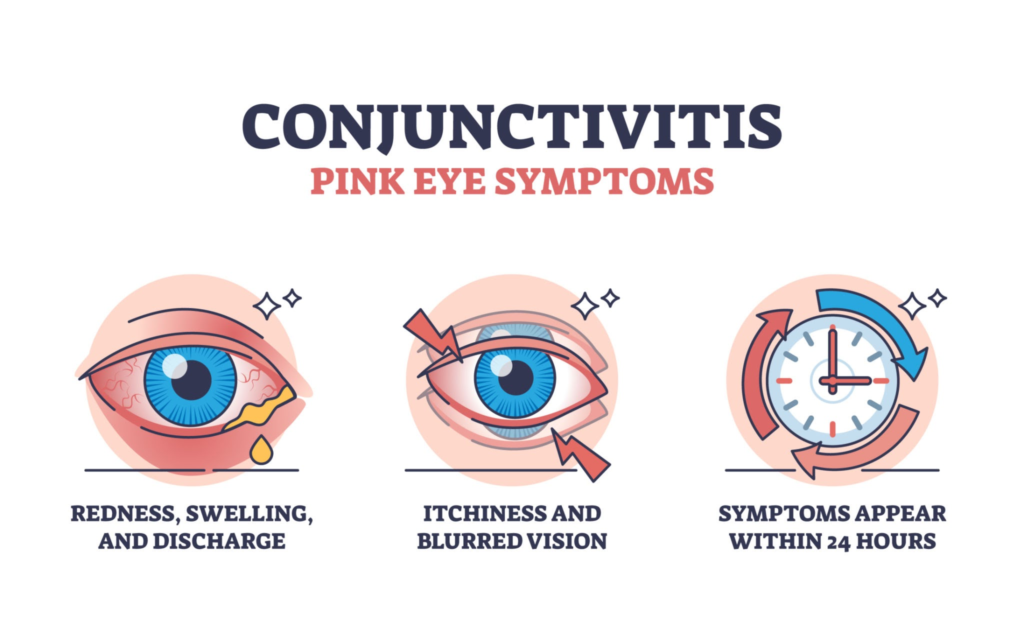
- It is primarily caused by allergens such as pollen or pet dander, leading to intense itching, watery eyes, and is not contagious, often improving with antihistamines and allergen avoidance.
- It is caused by adenovirus, produces watery discharge with mild discomfort, spreads easily through respiratory droplets, and typically resolves on its own without specific treatment.
- It results in thick yellow-green discharge, redness, irritation, and is treated with antibiotic eye drops.
- It usually appears after exposure to bright light, causing temporary eye dryness and mild burning, and is managed with lubricating drops and resting the eyes.
Question 9
Match each MRI description with the correct diagnosis.
- Meningitis: Inflammation of the protective layers (meninges) around the brain.
- Encephalitis: Inflammation of the brain tissue.
- Meningoencephalitis: Inflammation affecting both the protective layers and the brain tissue.
Question 10
True or False: Both Acute Flaccid Myelitis (AFM) and Bell’s Palsy can present with drooping of the mouth or eyelids as a symptom.
- True
- False
Question 11
True or False: $\textit{Listeria monocytogenes}$ remains confined to the bloodstream and does not pose a significant risk to the fetus during pregnancy.
- True
- False
Question 12
True or False: In case of Tetanus, death can occur from respiratory muscle spasms. Microbiology Final Exam
- True
- False
Question 13
True or False: Rabies, caused by a Lyssavirus transmitted primarily through bites and saliva, is believed to spread from muscle to the brain causing meningitis and agitation leading to death, and unfortunately there is no vaccine available.
- True
- False
Question 14
True or False: Cytomegalovirus (CMV) infection is a common congenital infection that is often asymptomatic in newborns but can harm mothers, causing fever, confusion and behavior changes.
- True
- False
Question 15
Which of the following statements are true? (5 correct answers) Microbiology Final Exam
- Genital herpes is more dangerous to pregnancy because it can be transmitted to the baby during childbirth, causing serious complications.
- Ureteritis: Infection of the bladder only.
- Cystitis: Infection of the ureters.
- Lactobacilli in the vagina may produce lactic acid, but their role in maintaining a healthy pH is minimal and not significant in preventing infections.
- E. coli is the most common cause of cystitis in females due to its abundance in the intestinal tract and the short female urethra, making it easy for bacteria to reach the bladder.
- Trichomonas vaginalis in men may cause painful urination, discharge, and itching or irritation.
- Estrogens promote the growth of it Lactobacilli in the vagina, which help maintain a healthy acidic environment to prevent infections.
- Urethritis: Infection of the urethra.
- Vaginosis refers to inflammation of the vaginal area, while vaginitis is an imbalance in vaginal bacteria, which is typically absent in G. vaginalis infections.
- Pyelonephritis: kidney and bladder Infection
Question 16
Fill in the blanks: Gonorrhea, caused by ___________ gonorrhoeae, is a sexually transmitted infection that often leads to ___________ in both men and women. In men, it can cause painful urination and a discharge of ___________, while women may experience few symptoms but are at risk for complications like ___________. If untreated, gonorrhea can also cause ___________ in newborns during childbirth, leading to serious eye infections.
- Blank 1: $\textit{Neisseria}$
- Blank 2: Urethral inflammation
- Blank 3: Pus
- Blank 4: Pelvic inflammatory disease
- Blank 5: Ophthalmia neonatorum
Question 18
Match the oral health diagnoses with the correct descriptions/images.
- Patient 1 – Caries
- Patient 2 – Acute Necrotizing Ulcerative Gingivitis (ANUG)
- Patient 3 – Gingivitis
- Patient 4 – Periodontitis (Bone and tissue supporting the teeth are destroyed)
Question 19
Prioritizing Patient Care in the Emergency Room
As a nurse in an emergency room setting, it’s crucial to assess and prioritize patients based on their symptoms, medical history, and potential for complications. In this exercise, you will be reviewing two patient cases: two adults with mild and severe gastrointestinal symptoms.
Patient A (Adult Male):
- Age: 52-year-old male
- Sudden onset of vomiting, nausea, and diarrhea 2 hours after eating leftover pasta.
- No fever, just weakness and dizziness.
- No abdominal pain or cramping, and no blood in stool.
- Symptoms were intense but short-lived.
Patient B (Cancer survivor Adult Female): Microbiology Final Exam
- Age: 46-year-old, breast cancer survivor patient
- Gradual onset of mild abdominal cramping and bloating.
- Developed high fever (103°F), chills, and severe abdominal pain.
- Blood in stool, dry mouth, and difficulty breathing.
- Unable to tolerate fluids, feeling weak and fatigued.
- Recent chemotherapy and immunosuppressive medication.
- Based on the symptoms, which patient is more likely to be suffering from an infection and which one is more likely to be suffering from intoxication?
- Patient A: Intoxication; Patient B: Infection
- Which patient should be prioritized in the ER lineup, and why?
- Patient B should be prioritized because she is immunocompromised, has a high fever, severe pain, and signs of a systemic or invasive infection (blood in stool, difficulty breathing).
Question 21
Link the descriptions/pictures with the appropriate disease
- Image of head showing common pressure locations, inflamed sinus lining, and mucus. Inflammation often linked to headaches.
- Image of mouth showing soft palate, uvula, and inflamed tonsils.
- 1. Sinusitis
- 2. Tonsillitis
Question 22
Check the False Statements. Which of the following statements are false? (5 answers) Microbiology Final Exam
- Antigenic shift can result from the mixing of genetic material between two different viral strains.
- Antigenic drift involves small, gradual mutations that alter viral surface proteins over time.
- Damage to respiratory cilia improves the body’s ability to fight off infection.
- Antigenic shift happens slowly over many years through random mutations.
- Scarlet fever is a viral illness that causes a red rash and swollen tongue.
- A positive Mantoux test always confirms that the person currently has active tuberculosis.
- One type of coronavirus was first reported in the Middle East in 2012 and caused a serious respiratory syndrome.
- Influenza B is more severe and more likely to cause pandemics than Influenza A.
- Haemophilus influenzae type b is a common cause of epiglottitis in children.
- The DTaP vaccine protects against diphtheria, pertussis, and tetanus.
Question 25
In this exercise, you are tasked with identifying the five primary modes of action of antibiotics based on the descriptions provided. Fill in the blanks with the corresponding mode of action
- Penicillins block peptidoglycan synthesis in bacterial cell walls, weakening them and causing cell lysis. This works best on growing gram-positive bacteria.
- Chloramphenicol blocks peptide bond formation at the 50S subunit, erythromycin (a macrolide) binds to the 50S subunit, streptomycin alters the shape of the 30S subunit, and tetracyclines prevent tRNA attachment to the ribosome.
- Rifamycin and quinolones inhibit bacterial nucleic acid synthesis by blocking RNA polymerase and DNA gyrase, respectively.
- Polymyxins disrupt the plasma membrane, and antifungal drugs like Amphotericin B bind to membrane sterols, causing cell damage.
- Sulfa drugs mimic PABA and…
- 1. Inhibition of cell wall synthesis
- 2. Inhibition of protein synthesis
- 3. Inhibition of nucleic acid replication and transcription
- 4. Injury to plasma membrane
- 5. Inhibition of essential metabolite synthesis
Question 26
Below is a graph showing blood concentration (mg/L) over time (hours) for three medications: Medication A, Medication B, Medication C (combination of A and B). Study the graph carefully. Answer the questions using the information shown and your understanding of pharmacological interactions.
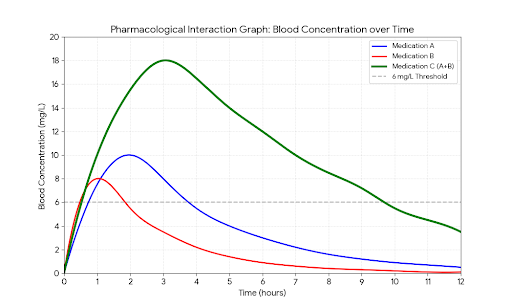
- Which medication reaches the highest peak concentration?
- How long does each medication stay above 6 mg/L in the blood?
- Based on the graph, what can you infer about the effect of combining Medication A and Medication B (Medication C)?
- Does the combination (Medication C) show evidence of antagonism? Why or why not?
- 1. Medication C
- 2. Medication A: ~4 hours; Medication B: ~2 hours; Medication C: ~8 hours
- 3. The effect is synergistic; the combination results in a significantly higher peak and longer duration than the sum of the individual drugs.
- 4. No, it shows synergism, not antagonism, because the combined effect is greater than either drug alone.
Farmer Case Scenario
A 64-year-old man from a farming community comes to the clinic with complaints of severe burning pain and numbness in his legs. He also reports strange visual hallucinations and episodes of confusion that began earlier this week. On examination, there is evidence of reduced blood flow to his lower limbs, including purple discoloration of his toes, this can lead to gangrene (tissue death due to lack of blood flow). He has no fever, jaundice, abdominal pain, or gastrointestinal bleeding. Moreover, he says the symptoms started after a local celebration where many residents consumed bread made from rye stored over the winter. He denies alcohol or drug use and had no history of liver disease. Lab tests show normal liver function, and an abdominal exam is unremarkable. Which of the following is the most likely diagnosis? Why?
- A. Ergot poisoning
- B. Hepatitis D
- C. Helicobacter: Peptic Ulcer Disease
Why: The symptoms of vasoconstriction (burning pain, gangrene) and hallucinations (St. Anthony’s Fire) are caused by ergot alkaloids from fungus-contaminated rye.
