
Question 12
Anatomy Arthrology Exam. A biaxial joint allows for movement in how many planes?
- Two planes
- One plane Anatomy Arthrology Exam
- Three planes
- Four planes
Question 13
A biaxial joint, such as the metacarpophalangeal joint, allows movement in three planes.
- True
- False
Question 14
Sutures are classified functionally as a ________ because they prevent most movement between the bones.
- Synarthrosis
- Amphiarthrosis
- Synovial joint
- Diarthrosis
Question 15
The primary function of the fontanelles during birth is provide ________ to the skull, which helps the infant’s head pass through the birth canal.
Stop Guessing On Nursing Exams
Thousands of nursing students are already using ATI Proctored Exams to practice realistic NCLEX and ATI TEAS-style questions before their exams.
Unlock Free Mock Tests →- Rigidity
- Protection
- Flexibility
- Hardness
Question 16
What happens to the epiphyseal plate as a child reaches puberty?
- The bone lengthening accelerates.
- The epiphyseal plate is replaced by bone, and the diaphysis and epiphysis fuse together.
- The cartilage continues to grow at the same rate as the bone.
- The cartilage thickens by does not change.
Question 17
An example of a narrow-gap symphysis is the ________, where the pubic portions of the right and left hip bones are joined by fibrocartilage.
- Pubic symphysis
- Manubriosternal joint
- Intervertebral disc
- Glenohumeral joint
Question 18
The fibrocartilage in a symphysis does not contribute to resistance during high-impact activities like running or jumping.
- True
- False
Question 19
Match the key terms on the left with the correct definitions on the right.
- Articular Capsule: A fibrous connective tissue structure that forms the walls of the joint cavity, attaching to the bones.
- Synovial Fluid: A thick, slimy fluid that lubricates the joint and provides nutrients to the articular cartilage.
- Articular Cartilage: A thin layer of hyaline cartilage that covers the bone’s articulating surface and reduces friction.
- Synovial Membrane: The membrane lining the inner surface of the articular capsule that secretes synovial fluid.
- Joint Cavity: A space filled with synovial fluid where the bones of a synovial joint articulate.
Question 20
What is the primary function of the synovial fluid in synovial joints?
- To provide lubrication and absorb shock
- To create friction between the bones
- To protect the articular cartilage from wear and tear
- To hold the bones together
Question 21
Ligaments prevent ________ by anchoring bones together at synovial joints and preventing their separation.
- Bone growth
- Inflammation
- Osteoporosis
- Dislocation
Question 22
Intrinsic ligaments are fused to or incorporated into the wall of the articular capsule.
- True
- False Anatomy Arthrology Exam
Question 23
What is the primary function of an articular disc in synovial joints?
- To provide lubrication to the joint
- To unite the bones and smooth movements between them
- To increase the range of motion
- To increase joint flexibility
Question 24
What is the primary function of a bursa in a joint?
- To reduce friction between bones and other structures
- To store energy for muscle contraction
- To facilitate bone growth at the joint
- To provide structural support to the joint
Question 25
What is primary characteristic of a synarthrosis joint?
- Provides strong, immobile connections between bones
- Allows for limited flexibility, such as in the spine
- Allows for significant movement
- Facilitates smooth motion in the body
Question 26
The intervertebral discs are an example of:
- A joint with no cartilage
- A fibrous joint with complete immobility
- A synovial joint with extensive mobility
- A cartilaginous joint with limited mobility
Question 27
Diarthrotic joints are classified based on their:
- Ability to resist compression
- Shape and size of the joint capsule
- Type of movement and axes of motion
- Location in the axial skeleton
Question 28
What is a syndesmosis?
- A cartilaginous joint united by hyaline cartilage
- A fibrous joint in which two parallel bones are united by longer connective tissue
- A fibrous joint where bones are joined by short connective tissue fibers
- A synovial joint that allows free movement
Question 29
The interosseus membrane in the forearm provides stability similar to the syndesmosis of the leg, with limited movement to support forearm function.
- True
- False
Question 30
What is a gomphosis?
- A cartilaginous joint between vertebrae
- A freely movable joint found in the mandible
- A type of synovial joint found in the skull
- A specialized fibrous joint that anchors a tooth to its socket
Question 31
What is a characteristic feature of a pivot joint?
Stop Guessing On Nursing Exams
Thousands of nursing students are already using ATI Proctored Exams to practice realistic NCLEX and ATI TEAS-style questions before their exams.
Unlock Free Mock Tests →- A rounded portion of one bone rotates within a ring formed by another bone and a ligament
- Two bones move independently in multiple directions
- The bones remain immobile
- Both bones in the joint slide past one another
Question 32
How are hinge joints functionally classified?
- Triaxial
- Uniaxial
- Multiaxial
- Biaxial
Question 33
Which of the following joints allows for gliding movements between bones with flat or slightly curved articulating surfaces?
- All of the above
- Intercarpal joints of the wrist
- Intertarsal joints of the foot
- Acromioclavicular joint
Question 34
What is the primary characteristic of a ball-and-socket joint?
- It provides no movement.
- It involves a rounded head of one bone fitting into a concave socket of another bone.
- It is found only in the legs.
- It allows movement in only one direction.
Question 35
The ________ ligaments join the coracoid process of the scapula to the acromion of the scapula.
- Coracoacromial
- Glenohumeral
- Acromioclavicular
- Coracoclavicular
Question 36
The rotator cuff is a group of four muscles that provide the primary support for the shoulder joint.
- True
- False
Question 37
What structure helps deepen the socket of the glenoid cavity?
- The articular capsule
- The labrum
- The synovial membrane
- The rotator cuff
Question 38
The rotator cuff is a circle of tendons around the shoulder joint, which is comprised of the following muscles:
- Supraspinatus, infraspinatus, teres minor, and subscapularis
- Biceps brachii, triceps brachii, and deltoid
- Pectoralis major and latissimus dorsi
- Trapezius and rhomboids
Question 39
The ________ is a strong ligament that supports the hip joint by connecting the ilium of the hip bone to the femur.
- Iliofemoral ligament
- Ischiofemoral ligament
- Pubofemoral ligament
- Ligament of the head of the femur
Question 37
The cruciate ligaments are named for the ________ attachment to the tibia.
- Posterior and medial
- Lateral and medial
- Anterior and lateral
- Anterior and posterior
Question 38
The cruciate ligaments are named for their location on the femur, as they cross each other inside the knee joint.
- True
- False
Question 39
The acetabulum is the ________ portion of the hip joint.
- Cartilage
- Tendon
- Socket
- Ligament
Question 40
The acetabular labrum is a structure made of bone that deepens the acetabulum and adds stability to the joint.
- True
- False
Question 41
A synchondrosis can be either temporary, like the epiphyseal plate of a growing long bone, or permanent, as seen in the thoracic cage.
- True
- False
Question 42
What distinguishes the first sternocostal joint from the remaining sternocostal joints in the thoracic cage?
- It ossifies with age.
- It is a synovial joint.
- It is not connected to costal cartilage.
- It forms a permanent synchondrosis.
Question 43
The hip joint provides strength and stability during standing and walking, even though it has less range of motion than the shoulder.
- True
- False
Question 44
Which joint type includes the knuckle joint and the wrist joint?
- Condyloid joint
- Ball-and-socket joint Anatomy Arthrology Exam
- Hinge joint
- Saddle joint
Question 45
Which of the following joints is an example of a saddle joint?
- Hip joint
- Elbow joint
- Atlantoaxial joint
- First carpometacarpal joint
Question 46
Which type of joint includes the intercarpal and intertarsal joints?
- Plane joint
- Ball-and-socket joint
- Saddle joint
- Hinge joint
Question 47
What type of joint is the knee, and what movement does it allow? Anatomy Arthrology Exam
- Saddle; flexion and abduction.
- Hinge; flexion and extension.
- Ball-and-socket; rotation and extension.
- Pivot; circumduction and rotation.
Question 48
The patellar ligament connects the patella to the femur and assists the quadriceps femoris in stabilizing the knee joint.
- True
- False
Question 49
Which of the following statements about the menisci in the knee is correct?
- Both menisci are completely independent of the tibial collateral ligament.
- The lateral meniscus is attached to the tibial collateral ligament.
- The menisci help absorb shock and provide padding between the femur and tibia.
- The menisci have a rich arterial blood supply and heal quickly when damaged.
- The medial meniscus has more free movement than the lateral meniscus.
Question 50
The primary stabilizing role of the rotator cuff muscle tendons involves limiting shoulder joint movement and keeping the…
- Answer (Transcribed): …head of the humerus in the glenoid cavity.
Question 51
Which of the following types of diarthrotic joints is shown in the image below?
- Diaxial
- Biaxial
- Multiaxial
- Uniaxial
Question 52
The glenoid cavity of the scapula is smaller than the head of the humerus, requiring ligaments to stabilize the shoulder joint.
- True
- False
Question 53
Which of the following joints is shown in the image below, as indicated by the target box?
- Intervertebral
- Sternoclavicular
- Sternocostal Anatomy Arthrology Exam
- Sacroiliac
Question 54
Which of the following joints is shown in the image below, as indicated by the target box?
- Acromioclavicular
- Sacroiliac
- Glenohumeral
- Radioulnar
Question 55
What feature is exclusive to synovial joints and not found in fibrous or cartilaginous joints?
- Joint cavity
- Ligaments
- Articular cartilage
- Fibrocartilage
Question 56
Which of the following joints is shown in the image below, as indicated by the target box?
- Intervertebral
- Temporomandibular
- Atlanto-axial
- Costovertebral
Question 57
Which of the following joints is shown in the image below, as indicated by the target box?
- Coxal
- Sacroiliac
- Pubic symphysis Anatomy Arthrology Exam
- Tibiofibular
Question 58
Which of the following joints is shown in the image below, as indicated by the target box?
- Radiocarpal
- Carpometacarpal
- Intercarpal
- Metacarpophalangeal
Question 59
The easiest and least expensive test to help positively identify osteoarthritis and rule out other causes of joint pain is an X-ray.
- True
- False
Question 60
All of the following are associated with a synovial joint EXCEPT:
- Synovial fluid
- Articular cartilage
- Tendon tissue
- Joint capsule
Question 61
A patient with osteoarthritis may struggle with:
- Challenges in performing daily activities
- Increased joint flexibility
- Decreased pain during activity Anatomy Arthrology Exam
- Rapid healing of joint tissues
Question 62
After the age of 55, women are more likely than men to develop osteoarthritis in the fingers and knees.
- True
- False
Question 63
Risk factors for developing osteoarthritis include previous joint injuries, obesity, and genetics.
- True
- False
Question 63
Dislocation of the shoulder occurs when the ____ of the humerus is removed from the ____ cavity.
- Head
- Glenoid Anatomy Arthrology Exam
Question 64
Fat pads, located around synovial joints, have no role in joint protection or stability.
- True
- False
Question 65
Name the following component of the knee joint.
- Posterior Cruciate Ligament (PCL)
Question 66
Nonsteroidal anti-inflammatory drugs (NSAIDs) are used to treat bursitis caused by trauma or overuse.
- True
- False
Question 67
Name the ligament shown in the image.
- Fibular collateral ligament (Lateral collateral ligament)
Question 68
Name the ligament shown in the image.
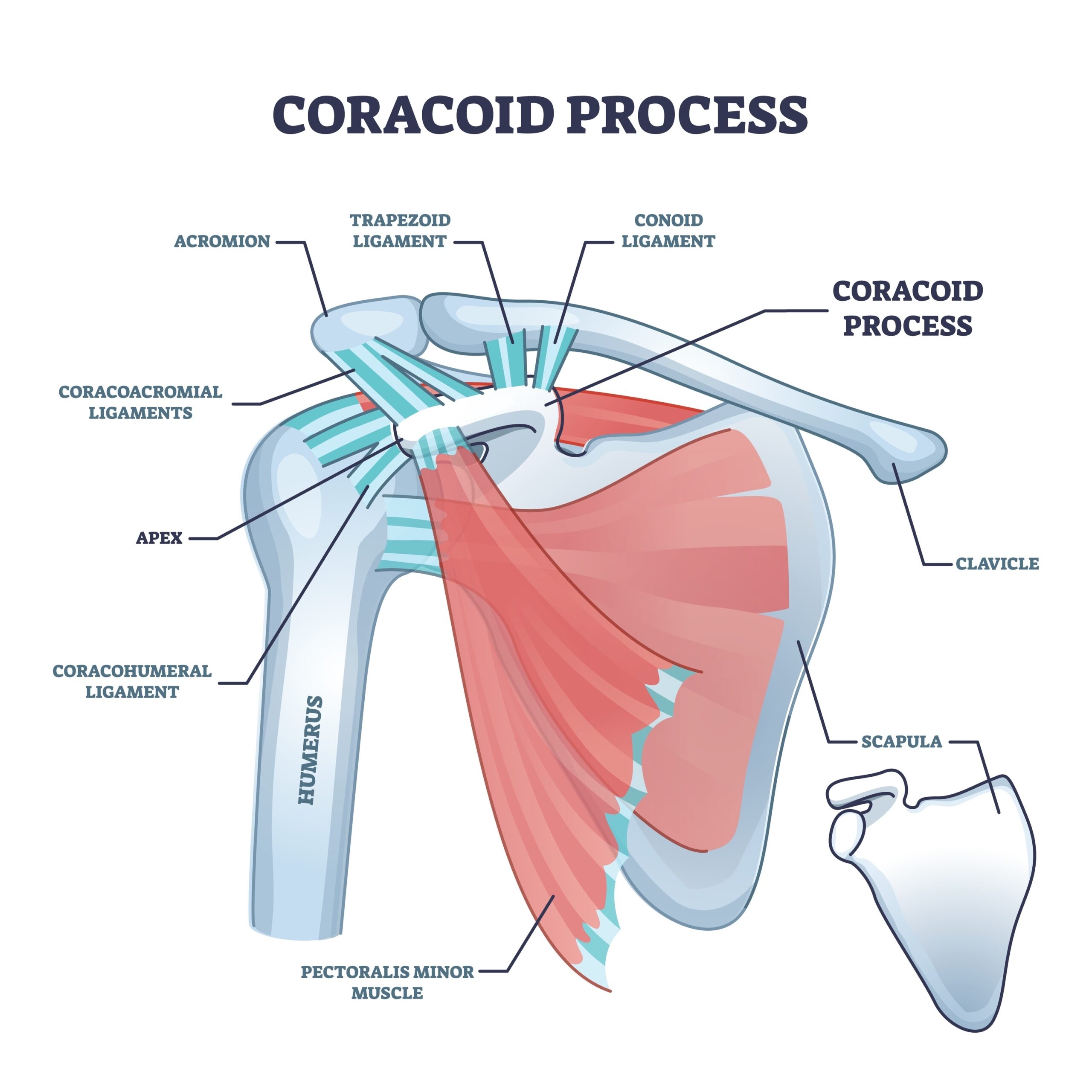
- Coracoacromial ligament
Question 69
Ligaments connect bones to muscles and limit excessive joint movement.
- True
- False (Ligaments connect bone to bone)
Question 70
A 32-year-old office worker complains of shoulder stiffness and pain after spending long hours typing without breaks. Examination reveals localized swelling and tenderness near the shoulder joint. What condition does she likely have, and what could be a contributing factor? Anatomy Arthrology Exam
- Condition: Bursitis (or Tendinitis)
- Contributing Factor: Repetitive strain / Overuse
Question 71
A 40-year-old woman presents with symmetrical joint swelling and pain in her hands and wrists. She reports morning stiffness lasting over an hour and fatigue. Blood tests reveal elevated inflammatory markers. Which type of arthritis is most likely, and what is the underlying cause?
- Type: Rheumatoid Arthritis
- Cause: Autoimmune reaction
Question 72
How do changes in the intervertebral discs affect spinal flexibility and injury risk with age?
- Flexibility: Decreases due to disc dehydration and thinning, which restricts range of motion.
- Injury Risk: Increases as the discs become more brittle, leading to a higher risk of herniation and less effective shock absorption for the vertebrae.
